This comparison is written by AvoKind — so you should know our bias going in. We have a stake in this outcome. What we can offer is a factual breakdown based on publicly available information about each brand, along with an honest acknowledgment of where AvoKind wins, where competitors are strong, and where the trade-offs are real.
We believe informed buyers make better customers. If you read this and decide a competitor is the right fit for you, that's a legitimate outcome.
Understand What These Three Brands Actually Are
Before comparing ingredient labels, it's worth clarifying that these three brands are not the same type of product. Treating them as equivalent is the first mistake most comparison articles make.
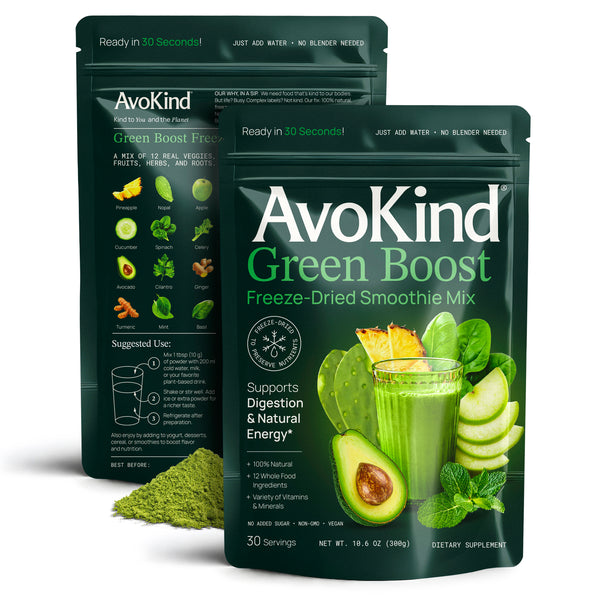
AvoKind is a freeze-dried smoothie powder. It ships shelf-stable at room temperature, mixes with any liquid in 30 seconds, and requires no blender or refrigeration. It is sold as a pouch of powder you use daily.
Kencko is also a freeze-dried smoothie powder, sold in single-serve sachets. Like AvoKind, it is shelf-stable, requires no blender, and mixes with water or milk. It is the most direct competitive comparison to AvoKind.
Daily Harvest is a different product format entirely. It is a frozen smoothie — a pre-portioned cup of frozen whole fruit and vegetable pieces that you blend with liquid to order. It requires a blender, a freezer for storage, and produces a fresh blended smoothie rather than a powder-mixed drink. It is a legitimate, high-quality product — but comparing it to a powder is comparing apples to a different kind of apples.
We are including Daily Harvest because consumers frequently search for all three together. Where the comparison is meaningful we will draw it. Where the product formats are too different for a fair direct comparison, we will say so.
Read the Ingredient Labels — Here Is What Each One Actually Contains
AvoKind Green Boost 12 whole-food ingredients: avocado, nopal, spinach, cucumber, celery, apple, pineapple, cilantro, ginger, turmeric, mint, basil. Every ingredient is freeze-dried at peak ripeness. No extracts. No isolates. No proprietary blends. No added ingredients of any kind.
Kencko Kencko's ingredient lists vary by flavor, but the brand's commitment across all products is the same: 100% organic fruits, vegetables, and spices — nothing added, nothing extracted except water. A typical Kencko smoothie contains 8–14 ingredients depending on the blend. No artificial additives, no added sugar, no preservatives. Kencko does not include avocado in any of its smoothie formulas. It does not include a whole-food fat source.
Daily Harvest Daily Harvest smoothies contain organic frozen fruits and vegetables, typically ranging from 6–12 ingredients. No added sugar, no preservatives, no artificial additives. The brand uses conventional and organic produce, with 95% of ingredients being organic. Frozen format preserves nutritional content well — though differently from freeze-drying. Daily Harvest does not include avocado as a core ingredient, nor a whole-food fat source across its standard smoothie range.
Know Where Each Brand Stands on Added Sugar
All three brands are genuinely zero added sugar. This is not a differentiator between them — it is a shared standard.
What separates them on the sugar question is the source and character of natural sugars:
AvoKind: Natural sugars come from freeze-dried pineapple and apple. The presence of avocado fat and nopal fiber slows the glycemic response of those sugars.
Kencko: Natural sugars come from the fruit ingredients in each blend. No fat source is present to modulate the glycemic response.
Daily Harvest: Natural sugars from frozen fruit. Some flavors use dates, which are a higher-sugar whole food. No added sugar, but total sugar can be elevated depending on the blend.
All three products meet the FDA's December 2024 updated "Healthy" claim standard for added sugar — ≤1g per serving for fruit and vegetable products.

Understand the Avocado Question — This Is Where the Comparison Gets Specific
This is the point where the comparison becomes specific to AvoKind's core claim — so we will be direct about what the science says and what it means for consumers comparing these products.
Vitamins A, E, and K are fat-soluble. They require dietary fat to be absorbed. Without a fat source in the formula, a meaningful portion of these vitamins pass through the body unused — regardless of what's listed on the label.
AvoKind includes freeze-dried avocado in every formula. Its oleic acid — a monounsaturated fat — functions as the absorption vehicle for the fat-soluble vitamins in spinach, cilantro, turmeric, and other ingredients in the bag. A Purdue University study published in Molecular Nutrition & Food Research found that monounsaturated fat enabled equivalent fat-soluble vitamin absorption at just 3 grams — the same result that required 20 grams of saturated fat to match.
Neither Kencko nor Daily Harvest includes avocado or any other whole-food fat source in their standard formulas. This means that consumers relying on those products for fat-soluble vitamin intake may be absorbing less than the label suggests. This is not a criticism of those brands' formulation choices — it is an honest statement about a nutritional gap that exists across most of the category.
See How Each Brand Addresses Gut Health and Fiber
AvoKind: Gut support comes from two sources — nopal cactus (a whole-food prebiotic containing both soluble and insoluble fiber) and avocado's natural fiber. No added probiotics, digestive enzymes, or isolated inulin. A randomized controlled trial published in Neurogastroenterology & Motility found that nopal fiber supplementation improved IBS symptoms across subtypes. The fiber source is the whole food itself.
Kencko: Gut support comes from the fiber naturally present in freeze-dried fruits and vegetables. Kencko does not add isolated probiotics or prebiotics to its standard smoothie line.
Daily Harvest: Gut support comes from whole-food fiber in frozen fruits and vegetables. Some flavors include chia seeds, flaxseeds, or oats, which add fiber.
On the prebiotic question — a meaningful distinction:
Most greens powders that market gut health benefits add isolated inulin to their formula. Inulin is a legitimate prebiotic and its effects are well-documented. But isolated inulin is not the same as whole-food fiber.
A 2023 study in Frontiers in Nutrition compared outcomes between people consuming a naturally high-fiber whole-food diet and those supplementing with isolated inulin. The finding: isolated inulin supplementation was associated with reduced microbial diversity compared to the whole-food fiber approach.
AvoKind's prebiotic fiber comes from nopal cactus — a whole food with soluble fiber, insoluble fiber, polyphenols, and betalains working together. Isolated inulin feeds certain bacteria. Nopal feeds an ecosystem.
Compare Format, Convenience, and Logistics Side by Side

See Where Each Brand Wins Honestly
AvoKind wins on:
- The only brand with avocado — and the fat-soluble vitamin absorption mechanism that comes with it
- Whole-food prebiotic fiber from nopal cactus (not added isolates)
- Zero added sugar with a natural glycemic buffer from avocado fat and fiber
- Lowest price per serving in this comparison
- No blender · no cold chain · no proprietary blend · 12 disclosed ingredients
Kencko wins on:
- Established brand with years of market presence and consumer reviews
- Organic certification across the full product range
- Single-serve sachet format for portioned convenience
- Wider flavor variety across the smoothie lineup
- B Corporation certification and strong sustainability credentials
- Presence in major retail — Target and Walmart
Daily Harvest wins on:
- Fresh-blended texture and sensory experience — closer to a real smoothie
- Much wider product range including bowls, oat bowls, elixirs, and protein boosters
- Nutritionist-crafted formulations with whole frozen ingredients
- Premium whole-food format for consumers who want to blend
Know What This Comparison Does Not Settle
This comparison is ingredient- and format-focused. It does not address:
Taste. Smoothie preference is highly personal. The only way to know what you prefer is to try them.
Long-term subscription experience. Customer service quality, flexibility, and ease of cancellation are best assessed through recent verified reviews.
Individual health goals. If your primary goal is post-workout protein, Daily Harvest's protein smoothies or Kencko's protein add-on may serve you better than AvoKind at this stage. AvoKind is not a protein product.
Organic certification. Kencko is fully certified organic. AvoKind uses clean, non-GMO ingredients but is not currently USDA certified organic across all inputs.
The Bottom Line
All three brands are legitimate products built on real food, without added sugar or artificial ingredients. None of them are a poor choice.
The specific difference AvoKind offers is one that most of the category ignores: the fat-soluble vitamin absorption mechanism. If the vitamins in your smoothie powder are going to do their job, fat needs to be present. AvoKind is the only brand in this comparison — and one of the very few brands in the greens powder category — that addresses this directly with a whole-food ingredient.
If that matters to you, AvoKind was built around it. If it doesn't factor into your priorities, Kencko is a strong, clean, well-established option — and Daily Harvest offers a premium blended experience at a different price point and format.
Read the labels. Compare what you care about. Buy what fits your life.
Frequently Asked Questions
Is AvoKind organic? AvoKind uses clean, non-GMO, additive-free whole-food ingredients. Not all inputs are currently USDA certified organic. Kencko is fully certified organic.
Can I use Daily Harvest without a blender? No. Daily Harvest smoothies are frozen whole-food cups that require blending. AvoKind and Kencko are powders that mix without a blender.
Does Kencko have avocado? No. Kencko does not use avocado in any of its smoothie formulas.
Is AvoKind cheaper than Kencko? At standard serving sizes, AvoKind's price per serving is generally lower than Kencko's subscription pricing of $2.49–$2.99 per sachet.
Which brand is best for gut health? All three brands provide whole-food fiber. AvoKind's use of nopal cactus — a whole-food prebiotic with published clinical trial evidence — is a specific differentiator. Kencko and Daily Harvest rely on the naturally occurring fiber in their fruit and vegetable ingredients.
Is Daily Harvest freeze-dried? No. Daily Harvest uses a frozen format — whole fruits and vegetables frozen at peak ripeness, not freeze-dried. This requires a blender and freezer storage.
Want to see what others are saying? Check our product reviews here.