Walk into any health food store and scan the greens powder section. You will find spirulina, chlorella, inulin, green tea extract, and ashwagandha in almost every formula on the shelf. What you almost certainly will not find — despite being one of the most nutritionally rich, gut-supportive, whole food prebiotic fiber sources available — is nopal.
Nopal cactus. The prickly pear. A plant that has fed people across Mexico and Mesoamerica for more than 9,000 years. A food with a robust body of scientific literature supporting its benefits for gut health, blood sugar steadiness, and digestive comfort. A whole food ingredient that the greens powder industry has quietly, almost universally, decided to skip.
This is not an accident. It is a choice. And understanding why that choice was made — and what it costs you nutritionally — is one of the more honest conversations the wellness industry has been avoiding.
Understand What Nopal Actually Is
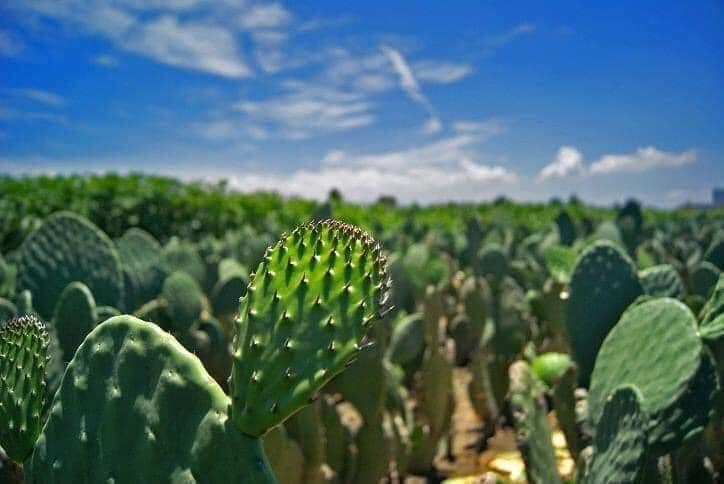
Nopal is the flat, paddle-shaped stem of the prickly pear cactus — Opuntia ficus-indica — native to Mexico and widely cultivated throughout Latin America, the Mediterranean, and North Africa. In Mexican cuisine, it has been eaten grilled, raw, in salads, soups, and juices for generations. It is not a supplement. It is not an extract. It is food.
Nutritionally, nopal is remarkable for its fiber profile. It contains both soluble and insoluble fiber — mucilage, pectin, and cellulose — along with betalains, flavonoids, polyphenols, vitamin C, calcium, and magnesium. This is not a compound isolated in a laboratory. This is the full nutritional complexity of a plant that has been eaten as everyday food for thousands of years.
The fiber in nopal behaves as a prebiotic — meaning it feeds and supports the beneficial bacteria in your gut microbiome rather than being absorbed directly. But unlike isolated prebiotic fiber supplements, nopal provides this benefit within its full food matrix, alongside the companion compounds that influence how that fiber is used.
Learn Why Prebiotic Fiber Matters More Than Most Labels Admit
The gut microbiome is not a single organism. It is an ecosystem — trillions of bacteria, fungi, and microorganisms that influence digestion, immune function, inflammation, mood, and nutrient absorption. What you feed that ecosystem determines how well it functions.
Prebiotic fiber is the primary food source for beneficial gut bacteria. Without adequate prebiotic fiber in the diet, beneficial bacterial populations decline, and the less beneficial ones fill the space. The downstream effects — digestive discomfort, bloating, irregular digestion, reduced immune function — are among the most common health complaints in the modern diet.
The global gut health market is worth $7.5 billion and growing at 8.2% annually.
Consumers are paying attention. The problem is that most of the products marketed for gut health are using the cheapest, most simplified fiber source available: isolated inulin extracted from chicory root.
Inulin works. But it is one compound. Nopal is a whole food containing dozens.
See Why Isolated Inulin Is Not the Same as Whole-Food Fiber
Isolated inulin is extracted from chicory root, purified, and added to formulas in precise measured doses. It is cheap, shelf-stable, and well-documented in clinical research. For manufacturers, it is the obvious choice.
But the gut microbiome did not evolve to thrive on isolated compounds. It evolved to thrive on whole food. And whole food fiber sources are structurally different from their isolated counterparts in ways that have measurable biological consequences.
Research published in the Journal of Nutritional Science compared the gut microbiome effects of whole food fiber sources against isolated fiber supplements and consistently found that whole food sources produced greater diversity in beneficial bacterial populations. Diversity is the goal — not just the growth of one specific bacterial strain.
Nopal's fiber profile includes mucilage — a gel-forming soluble fiber that slows digestion, supports blood sugar steadiness, and creates a protective coating along the gut lining. It includes pectin — a soluble fiber that feeds a broad spectrum of beneficial bacteria. It includes cellulose — an insoluble fiber that supports gut motility and regularity.
Isolated inulin feeds certain bacteria. Nopal feeds an ecosystem. Those are not the same thing, and the greens powder industry has been treating them as if they are.
Discover What the Research Actually Says About Nopal
The scientific literature on nopal is more robust than most people realize — and more specific than the general claims made about fiber supplements.
Studies published in the Journal of Ethnopharmacology have documented nopal's role in supporting healthy blood sugar levels, attributed to its mucilage content slowing glucose absorption in the digestive tract. Research in Plant Foods for Human Nutrition has examined nopal's antioxidant and anti-inflammatory properties, connected to its betalain and polyphenol content. A clinical study published in Advances in Nutrition found that nopal supplementation produced measurable improvements in gut microbiome diversity over an eight-week period.
None of this is new. In Mexico, nopal has been used medicinally and nutritionally for centuries — not because of clinical trials, but because generations of people observed what it did for their health and kept eating it. The science is confirming what traditional food culture already knew. The greens powder industry just hasn't been paying attention.

Understand Why Most Brands Skip Nopal Entirely
If nopal is this effective, this well-researched, and this nutritionally rich — why is it absent from almost every whole food greens powder on the market?
The answer is practical, not scientific.
Nopal is harder to source than chicory-derived inulin. It requires specific agricultural conditions and more careful processing to preserve its nutritional profile. Freeze-drying nopal — the method that preserves 97% of its nutritional value — costs significantly more than extracting inulin from a widely available crop.
The greens powder industry chose isolated inulin because it is cheap, easy, and sufficient for marketing purposes. It allows brands to list "prebiotic fiber" on the label without the sourcing complexity, the processing cost, or the agricultural relationships that nopal requires.
AvoKind chose nopal. Not because it was the easy option — it clearly wasn't. But because a formula built around whole food ingredients, real bioavailability, and genuine gut support could not use a shortcut at the one point where gut health is specifically on the line.
How Nopal Works Inside AvoKind's Formula
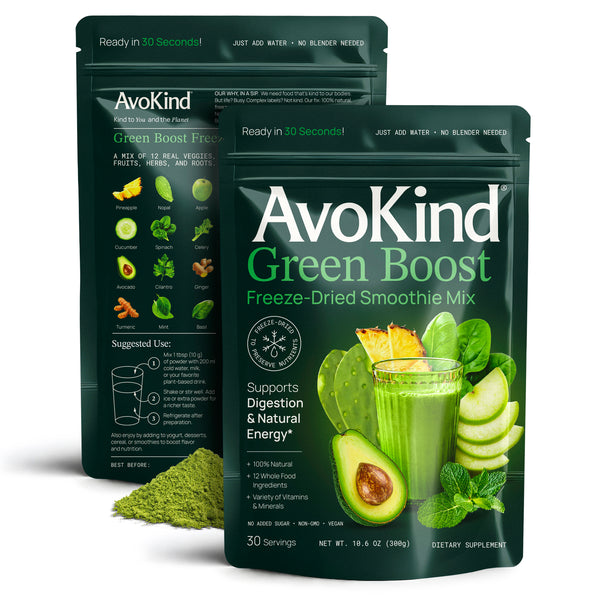
AvoKind contains 12 whole food ingredients: avocado, nopal, spinach, cucumber, celery, apple, pineapple, cilantro, ginger, turmeric, mint, and basil. Every one freeze-dried. Every dose disclosed. Nothing hidden in a proprietary blend.
Nopal's role in the formula is structural and specific. Its mucilage and pectin support digestive comfort — particularly relevant in the first two weeks of use as the gut microbiome adjusts to a new whole food fiber source. Its betalains work alongside the antioxidant compounds in turmeric, basil, and spinach. Its mineral content — calcium and magnesium — complements the electrolyte profile of the other ingredients.
And critically: nopal's prebiotic fiber works alongside avocado's oleic acid, which is already in the same serving unlocking fat-soluble vitamins A, E, and K from spinach, basil, and cilantro. The formula is a system. Nopal is not an add-on — it is a working part of that system.
What to Look For on a Label From Now On
The next time you evaluate a greens powder for gut health support, look for one thing: is the fiber source a whole food or an extract?
If the label says inulin — without specifying nopal, chicory root, or another whole food source — it is almost certainly isolated inulin. One compound. One bacterial population benefited. A fraction of what a whole food fiber source provides.
Whole food fiber looks like nopal. Like apple. Like cucumber. Like the actual plant, preserved in a form your gut recognizes. The difference between isolated inulin and nopal is the difference between feeding one guest at a dinner table and feeding the whole room. Your gut microbiome is the whole room.
Want to see what others are saying? Check our product reviews here.