Most nutrition conversations start and end with the label.
How many grams of vitamin C. How much vitamin K. Whether the greens powder you're considering has spinach or kale or both. These are the questions most people ask — and they are the wrong questions.
The right question is simpler and more uncomfortable: how much of what's on that label actually reaches your body?
The answer has a name. It's called bioavailability. And once you understand it, you will never evaluate a greens powder — or any nutrition product — the same way again.
Understand What Bioavailability Actually Is
Bioavailability is the proportion of a nutrient that is absorbed and used by the body after consumption. Not what's in the bag. Not what's on the label. Not what you swallow. What actually makes it through the digestive system, into the bloodstream, and to the cells that need it.
The gap between those two numbers — what's listed and what's absorbed — can be enormous. And it varies dramatically depending on the nutrient, the food form it comes in, what else is in the same serving, and how the food was processed before it reached you.
A product can list 100% of your daily vitamin A and deliver a fraction of that to your body. It is not lying. It is simply not telling you the full story. And the full story is where the real nutritional difference between products lives.
Learn Why the Form of a Nutrient Changes Everything
The same nutrient delivered in different forms can produce dramatically different outcomes in the body.
Vitamin C listed as "ascorbic acid" is an isolated compound — synthetically derived, precise in dose, and absorbed reasonably well in controlled conditions. Vitamin C delivered through freeze-dried acerola cherry comes packaged with bioflavonoids, enzymes, and co-factors that influence how that vitamin C is transported and used. Same nutrient on the label. Meaningfully different in the body.
This is what food scientists call the food matrix effect — the idea that nutrients in whole food behave differently than the same nutrients in isolated or extracted form, because the surrounding compounds influence absorption, transport, and utilization.
Research from Cornell University documented this effect across a wide range of phytonutrients, finding consistently that whole food sources produced superior bioavailability compared to isolated equivalents — not because the isolated form was inferior, but because the co-factors present in whole food are doing work the isolate cannot replicate. The label cannot tell you this. Only understanding the form can.
The Single Biggest Bioavailability Problem in Greens Powders
Of all the bioavailability gaps in the greens powder category, one stands out as the most common, most documented, and most consistently ignored. Vitamins A, E, and K are fat-soluble. They require healthy fat present in the same serving to be absorbed at all. Without it, they enter the digestive system, fail to be packaged into the chylomicron transport structures that carry them into the lymphatic system, and exit the body largely unused.
Research published in the Journal of Nutrition by Unlu et al. found that adding avocado to a meal increased carotenoid absorption by up to 15.3 times compared to the same meal without healthy fat. Not a rounding error. A structural difference in what the body could access.
Most greens powders are fat-free by design. Fat adds calories. Fat complicates shelf stability. Fat requires more careful sourcing. So the category removed it — and in doing so, made vitamins A, E, and K on the label largely decorative. The vitamins are present. The mechanism that makes them work is missing.

How Processing Affects Bioavailability Before the Product Reaches You
Bioavailability is not just about what's in the formula. It starts with how the ingredients were processed. Conventional drying methods — spray drying, drum drying, air drying — all use heat to remove moisture. Heat degrades heat-sensitive vitamins before the product ever reaches a shelf. Studies show conventional drying can reduce vitamin C content by up to 80%. Fat-soluble vitamins, enzymes, and polyphenols are similarly affected.
Research published in the Journal of Food Engineering found that freeze-dried produce consistently outperformed conventionally dried counterparts in nutrient retention across virtually every tested category — preserving up to 97% of nutrients by removing only water, with no heat involved.
The process determines what is available to absorb before the bioavailability question even begins.
Understand the Five Factors That Determine Real Bioavailability
When you evaluate any nutrition product, these are the four questions that determine whether what's on the label reaches your body:
1. Is it a whole food or an isolate?
Whole food delivers the nutrient in its natural matrix with co-factors intact. Isolates deliver the target compound without the surrounding biology that influences how it behaves. Neither is categorically superior — but the distinction matters for specific nutrients.
2. Is healthy fat present for fat-soluble nutrients?
Vitamins A, E, and K require it. Without it, absorption of these nutrients drops dramatically regardless of the dose listed on the label.
3. How was the food processed before it reached the bag?
Heat destroys heat-sensitive nutrients before you consume them. Freeze-drying preserves them. The processing method determines the ceiling of what's available to absorb.
4. Are the nutrients in a form the body recognizes?
Synthetic isolated vitamins and naturally occurring food-matrix vitamins are absorbed through different pathways and behave differently in tissue. Beta-carotene from freeze-dried carrot and beta-carotene from a synthetic isolate are not identical in their bioavailability.

See What Bioavailability Looks Like in Practice
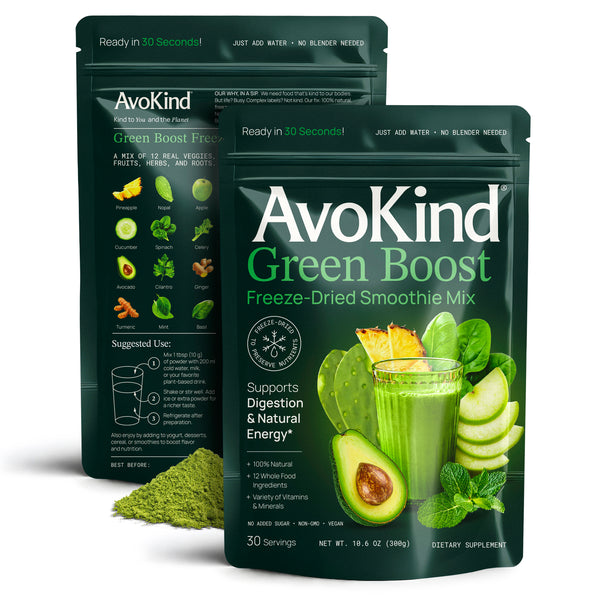
AvoKind Green Boost contains 12 whole food ingredients: avocado, nopal, spinach, cucumber, celery, apple, pineapple, cilantro, ginger, turmeric, mint, and basil. Every ingredient is freeze-dried — preserving 97% of nutrients with no heat involved. Every ingredient is a whole food — delivering the full nutritional matrix rather than isolated compounds.
And critically: avocado is the first ingredient. Its oleic acid — a monounsaturated fat — functions as the absorption vehicle for the fat-soluble vitamins in spinach, basil, cilantro, and turmeric. The formula is designed so that the delivery mechanism is built into the same serving as the nutrients it delivers.
Nothing extracted. Nothing isolated. Nothing hidden in a proprietary blend. The label and what reaches your body are as close as a food product can make them.
The Bottom Line
Bioavailability is the number no greens powder label shows you — and the number that determines whether your investment in nutrition is actually working. A label that lists 20 vitamins and minerals means nothing if the form, the processing method, or the absence of a fat source prevents your body from accessing them. Understanding bioavailability does not require a food science degree. It requires five questions — and the honesty to ask them about whatever product you are currently using.
The label tells you what went in. Bioavailability determines what comes out the other side.
Frequently Asked Questions
What is bioavailability in simple terms?
Bioavailability is how much of a nutrient your body actually absorbs and uses after you consume it — as opposed to what's listed on the label or what you swallow. A nutrient with low bioavailability passes through the body without being fully utilized.
Why do fat-soluble vitamins have lower bioavailability without fat?
Vitamins A, E, and K require dietary fat present at the same time to be packaged into chylomicrons — the transport structures that carry them from the digestive system into the bloodstream. Without fat, this transport mechanism cannot function and absorption drops significantly.
Does processing affect bioavailability?
Yes, significantly. Heat-based processing methods can reduce nutrient content by 30–80% before a product reaches you. Freeze-drying removes only water, preserving up to 97% of nutrients and keeping the bioavailability ceiling as high as possible.
Is a higher dose always better for bioavailability?
Not necessarily. A lower dose of a nutrient in a highly bioavailable whole food form can outperform a higher dose of the same nutrient in a poorly absorbed isolated form. Dose and bioavailability are separate variables — both matter.
What is the food matrix effect?
The food matrix effect refers to the way nutrients in whole food interact with surrounding co-factors, fiber, enzymes, and phytonutrients to influence absorption and utilization. Nutrients delivered through whole food behave differently in the body than the same nutrients delivered as isolates — often with meaningfully better outcomes.