You picked up a smoothie powder, turned it over, and started reading the ingredient list. Thirty ingredients. Fifty. Seventy-five. A proprietary blend or two. And somewhere in the process, you stopped being able to tell the difference between what's real and what's label math.
This post is written for that moment. It explains the four types of ingredients that appear in smoothie powders — whole foods, extracts, isolates, and fillers — what each one is, how to identify it on a label, and what it means for what actually makes it into your body.
This is not a product review. It is a category-wide explanation that applies to any brand you're evaluating — including ours.
Understand Why the Gap Between a Label and Real Nutrition Exists
A supplement label is a list of ingredients. It is not a guarantee of how much of each ingredient is present, how bioavailable those ingredients are, or whether the doses listed are clinically meaningful.
The FDA regulates supplement labels — but it does not evaluate them before products go to market. As Amy Eichner, PhD, Special Advisor on Drugs and Supplements for the U.S. Anti-Doping Agency, explains: "Companies can miss listing things or avoid listing things, and no one is going to catch it beforehand."
The result is a category where labels frequently signal health more than they deliver it. Understanding the difference between a label that reflects real food and one that is doing mathematical sleight-of-hand is worth the time it takes to learn.
Know the Four Ingredient Types — and What Each One Means for Your Body
1. Whole foods
Ingredients that are the actual food — or a minimally processed version of it — with nothing extracted, concentrated, or isolated.
Examples: freeze-dried spinach, freeze-dried avocado, pineapple powder, nopal cactus powder made from the whole cactus pad.
How to identify them: The ingredient name is simply the food itself, sometimes followed by a processing descriptor. "Freeze-dried avocado." "Pineapple powder." "Spinach." No asterisks, no ratio notations, no "extract of" language.
What they deliver: The full nutritional matrix of the ingredient — vitamins, minerals, fiber, enzymes, phytonutrients, and the co-factors that help the body absorb and use them. Whole food nutrition comes packaged the way nature designed it, with all components working together.
The trade-off: Whole food ingredients are typically more expensive per gram than extracts or isolates. This is why many brands use them sparingly, if at all.
2. Extracts
Concentrated versions of specific compounds taken from a food or plant. An extract isolates the parts of an ingredient a manufacturer considers most valuable and concentrates them, discarding or reducing the rest.
Examples: "green tea extract (standardized to 45% EGCG)," "turmeric extract (95% curcuminoids)," "ashwagandha extract (KSM-66)."
How to identify them: The word "extract" appears after the ingredient name, often with a parenthetical noting the standardized percentage of a target compound. A ratio like "10:1" means 10 parts of the original plant material were used to produce 1 part of the extract.
What they deliver: A higher concentration of specific compounds than a whole food would provide at the same serving weight. For some ingredients — sulforaphane from broccoli, withanolides from ashwagandha — an extract may be the only practical way to deliver a dose that research has shown to be effective.
The trade-off: Extracts deliver what was isolated, not the full nutritional matrix of the original food. The co-factors that may enhance absorption and function of the target compound are often absent.
3. Isolates
Individual compounds pulled entirely free from their food source and purified to high concentration. More extreme than extracts.
Examples: "inulin" (fiber isolated from chicory root), "ascorbic acid" (vitamin C isolated from its natural complex), "l-glutamine," "beta-glucan."
How to identify them: Isolates are typically listed by their chemical name rather than a food name. If you see "ascorbic acid" instead of "acerola cherry powder," the vitamin C is an isolate. If you see "inulin" rather than "chicory root" or "nopal," the fiber is isolated.
What they deliver: A precise, measured quantity of a single compound. Useful when a clinically effective dose of a specific nutrient is the goal.
The trade-off: Research increasingly suggests that isolated nutrients behave differently than the same compounds delivered through whole foods. A 2023 study in Frontiers in Nutrition compared outcomes between people consuming a naturally high-fiber whole-food diet and those supplementing with isolated inulin. The finding: isolated inulin supplementation was "associated with reduced microbial diversity" — the opposite of the intended effect. This does not make isolates categorically inferior, but it is worth knowing that "same compound, different delivery" is not always the same outcome.
4. Fillers, carriers, and functional additives
Ingredients that serve a manufacturing or product-stability purpose rather than a nutritional one. They help powders flow, resist clumping, extend shelf life, or carry other ingredients.
Examples: maltodextrin, silicon dioxide, magnesium stearate, natural flavors, rice flour.
How to identify them: They often appear at the end of the ingredient list and have chemical-sounding names. "Natural flavors" is a broad category that can cover a wide range of compounds.
What they deliver: Functionally — stability, texture, flow. Nutritionally — little to nothing.
The trade-off: Their presence does not automatically make a product unsafe. But a label where fillers appear prominently or early in the list suggests they represent a meaningful portion of the serving weight. A short filler list is a signal of cleaner formulation.
Learn How to Read a Proprietary Blend — and What It's Hiding
A proprietary blend is a group of ingredients listed under a collective name with a single total weight declared, but individual ingredient amounts not disclosed.
Under current FDA labeling rules, supplement manufacturers are not required to disclose the individual quantities within a proprietary blend. This matters for two reasons.
First, dose efficacy. Many ingredients in smoothie powders — ashwagandha, adaptogens, probiotics — have documented effective doses based on clinical research. If you don't know how much of each ingredient is present, you cannot assess whether the dose is clinically meaningful. A proprietary blend can legally use a very small amount of a premium ingredient to justify its presence on the label, while the bulk of the blend is a cheaper filler.
Second, individual tolerance. If you react poorly to something in a product and the amounts aren't disclosed, narrowing down the cause is significantly harder.
A clean-label product discloses every ingredient and its quantity. If a label uses proprietary blends without disclosing individual weights, that is worth noting — not necessarily as a disqualifier, but as information you deserve to have.
As Healthline's review of AG1 — which contains 75+ ingredients — notes: the proprietary blends "make it difficult to know whether you're consuming an effective dose" of specific ingredients.
Use This Practical Label-Reading Framework Before Your Next Purchase
1. Can you pronounce and identify every ingredient as a food? If yes, that is a signal of genuine whole-food formulation. If the list includes many chemical names, ratios, or vague terms like "proprietary blend," the product is likely built around extracts or isolates.
2. Are quantities disclosed for every ingredient? A label that hides individual ingredient amounts behind a proprietary blend is less transparent than one that lists every gram. This matters more for functional ingredients than for food ingredients, where the dose question is less critical.
3. Where do the sugars come from? Check "Total Sugars" and "Added Sugars" separately. Total sugars include naturally occurring fruit sugars — not a concern. Added sugars are a different matter. The FDA's December 2024 updated "Healthy" claim rule sets a cap of ≤1 gram of added sugar per serving for fruit and vegetable products. A product with 0g added sugar and naturally occurring fruit sweetness from freeze-dried pineapple or apple is formulated differently from one that uses cane sugar or fructose for palatability.
4. What is at the top of the ingredient list? Ingredients are listed by weight, highest to lowest. The first three to five ingredients represent the majority of what you're consuming. If the first ingredient is a filler, a blend, or a grass extract you don't recognize, that's where most of the serving weight is going.
5. Does a fat source exist to support fat-soluble vitamin absorption? This question almost never appears on product pages — but it is one of the most nutritionally significant. Vitamins A, E, and K are fat-soluble. They require dietary fat present at the same time to absorb. A formula without a whole-food fat source will list these vitamins on the label, but the body may absorb only a fraction of them. Research from Purdue University confirms healthy fats increase fat-soluble vitamin absorption by up to 4.5 times.
See What This Framework Looks Like Applied to a Real Product
We include this not as a sales pitch but as a concrete example of what these principles look like applied to a real label.
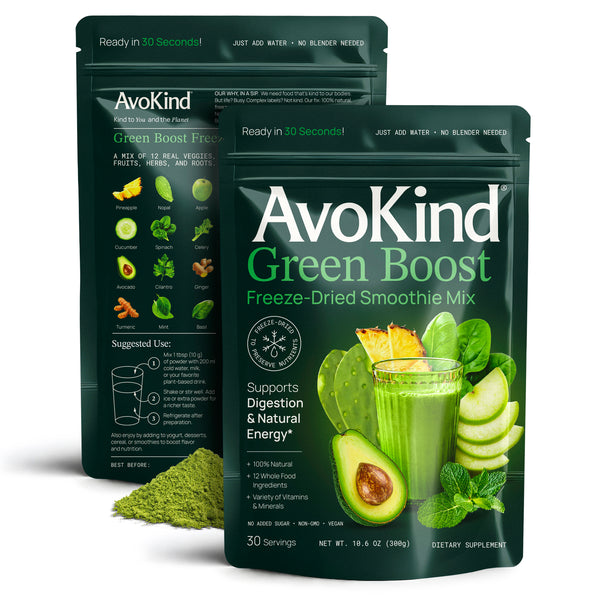
AvoKind Green Boost contains 12 ingredients: avocado, nopal, spinach, cucumber, celery, apple, pineapple, cilantro, ginger, turmeric, mint, and basil.
- Every ingredient is a whole food. None are extracts. None are isolates.
- No proprietary blends. Every ingredient is listed individually.
- 0g added sugar. Natural sweetness comes from freeze-dried pineapple and apple.
- No fillers, carriers, or synthetic additives. The ingredient list is the product.
- A whole-food fat source is present. Avocado's oleic acid supports absorption of the fat-soluble vitamins in spinach and other greens.
A formula with this structure is not inherently better than one using high-quality extracts — it is different, with different trade-offs. What it does deliver is exactly what it says: 12 whole foods, nothing more.
The Bottom Line
Smoothie powder labels are not difficult to read once you understand the four ingredient categories and what each one signals. Whole foods deliver the full nutritional matrix. Extracts concentrate specific compounds. Isolates pull individual nutrients free from their food context. Fillers stabilize and carry.
The question is not which category is categorically superior. It is whether the label in front of you accurately reflects what is actually inside the bag — and whether what is inside is aligned with what you are hoping to get.
A label you can read, understand, and verify in two minutes is always more trustworthy than one you need a food science degree to decode.
Frequently Asked Questions
Is "natural flavors" a red flag on a smoothie powder label? Not automatically. But its presence on a clean-label product is worth noting — a truly whole-food formula typically doesn't need flavoring additives, because the ingredients carry their own natural taste.
Are extracts ever better than whole foods in a smoothie powder? For certain ingredients, yes. Compounds like sulforaphane from broccoli and specific curcuminoid forms from turmeric are present in such small amounts in the whole food that an extract may be the only practical way to deliver a meaningful dose. The question is whether the trade-off — losing the co-factors and fiber of the whole food — is worth it for your specific health goal.
What does "standardized" mean on a supplement label? It means the extract has been processed to contain a guaranteed percentage of a specific compound. "Turmeric extract standardized to 95% curcuminoids" ensures batch consistency. It does not tell you the total dose — only the concentration.
If a product lists 50+ ingredients, does that mean it's more nutritious? Not necessarily. More ingredients mean more potential interactions, greater likelihood of proprietary blending, and increased formulation complexity. A shorter, transparent ingredient list is not inferior to a longer, partially obscured one.
How do I know if the amounts on a label are the amounts in the product? For ingredients specifically added, FDA regulations require products contain at least 100% of the declared quantity. Third-party testing by organizations like NSF International or USP provides independent verification.